Each scale has specific applications and limitations.
Step 3: Select Target Scale
Choose the scale you want to convert to. For more on the Rockwell hardness, visit our Rockwell hardness conversion calculator.
Vickers hardness number (HV), independent of the indentor size, is one of the broadest hardness scales used.
This tool helps you compare results across different testing standards with just a few clicks.
How it works:
Select the original measurement method.
Enter the measured value.
Choose the method you want to convert to.
The converter will calculate the result automatically.
Looking for a hardness tester?
For example, Rockwell C values typically range from 20 to 70, while Brinell values can range from 50 to 650 depending on the material and test conditions.
Step 2: Select Source Scale
Choose the hardness scale of your input value.
Hardness is a crucial property of materials, indicating their resistance to permanent deformation under applied force.
Some conversions are more accurate than others due to the fundamental differences in testing methods and scale characteristics.
Step 4: Optional Material Specification
Specify the material type if known, as this can improve conversion accuracy.
Our Vickers hardness number calculator will help you calculate the HV of any material.
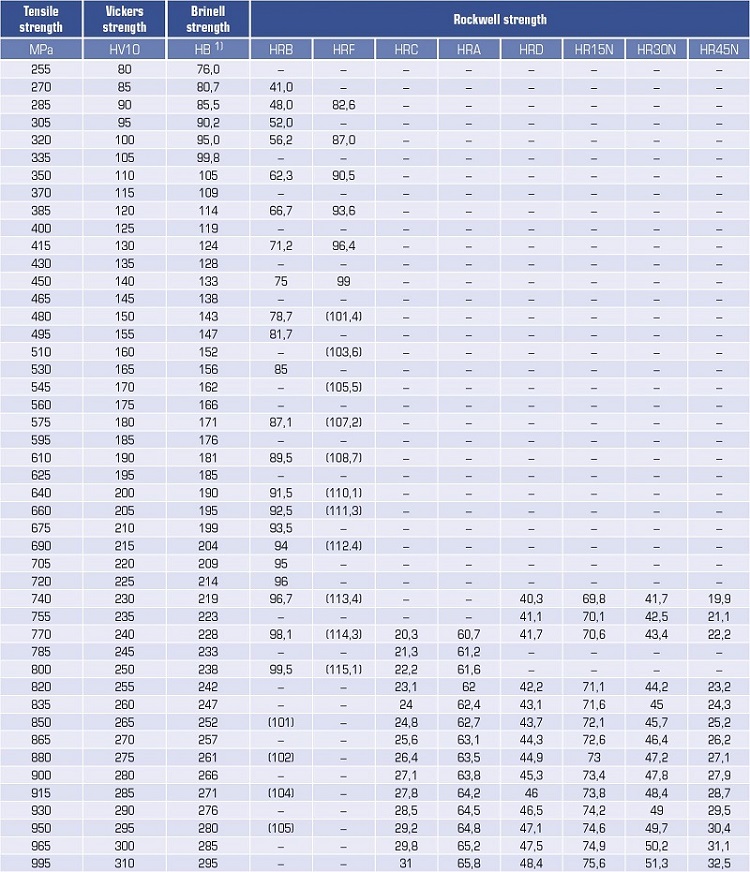
Steel hardness conversion chart
The hardness of steel depends on several factors, such as its composition, manufacturing, and heat-treating processes. Various hardness scales exist, each suited for specific materials or testing conditions.
On the other hand, Rockwell hardness (scales B and C) are dimensionless quantities.
Here’s a general approach:
Use a conversion formula:
For steels, a commonly used formula is:
HRC ≈ -0.000000567 HBW^2 + 0.0624 HBW – 13.7
Consult conversion tables:
Reference ISO 18265:2013 or other standardized conversion tables for more accurate results across different material types.
Consider material-specific formulas:
For certain alloys or heat-treated materials, specialized formulas may be more accurate.
Use a hardness conversion calculator:
Many online tools and software applications can perform this conversion quickly and accurately.
Example conversion:
Let’s convert a Brinell hardness of 350 HBW to Rockwell C:
HRC ≈ -0.000000567 350^2 + 0.0624 350 – 13.7
≈ 37.3 HRC
Related Calculators
Hardness converter for Vickers, Brinell, Rockwell, and Knoop
Easily convert hardness values between Vickers, Brinell, Rockwell, and Knoop methods.
Ensure the value is within the valid range for the source scale.
A hardness conversion calculator is a specialized tool designed to convert hardness values between different scales used in material science and engineering.
The process typically follows these steps:
Identify the Rockwell scale: Determine which Rockwell scale (e.g., HRA, HRB, HRC) the original measurement is in.
Choose the target scale: Decide which hardness scale you want to convert to (e.g., Brinell, Vickers).
Use a conversion formula or table: Apply the appropriate formula or consult a conversion table to transform the value.
Consider material type: Ensure the conversion is valid for the specific material being tested.
For example, to convert from Rockwell B (HRB) to Vickers (HV) for a copper alloy:
HV ≈ 1.0483 * HRB + 36.5
If we have a Rockwell B hardness of 70 HRB:
HV ≈ 1.0483 * 70 + 36.5
≈ 110 HV
What is the formula for hardness measurement?
Here are formulas for three common hardness tests:
Brinell Hardness (HB):
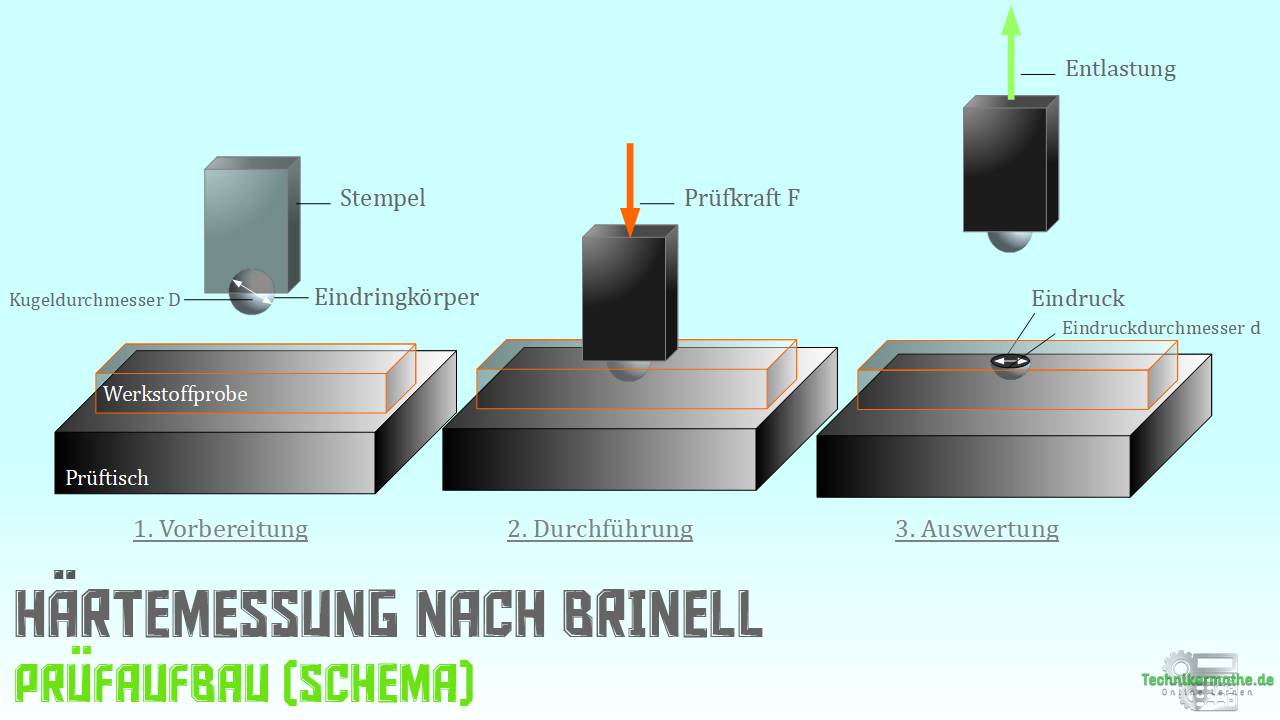
HB = 2F / (πD(D – √(D^2 – d^2)))
Where:
F is the applied force (in kgf)
D is the diameter of the indenter (in mm)
d is the diameter of the indentation (in mm)
Vickers Hardness (HV):
HV = 1.8544 * F / d^2
Where:
F is the applied force (in kgf)
d is the average length of the diagonals of the indentation (in mm)
Rockwell Hardness:
The Rockwell hardness is calculated based on the depth of indentation.
It also includes information on the accuracy and limitations of these conversions.
ISO 18265:2013 emphasizes that these conversions are approximate and should be used with caution, especially when dealing with materials that have undergone special heat treatments or manufacturing processes.
How to convert HBW to HRC?
Converting from Brinell hardness (HBW) to Rockwell C hardness (HRC) is a common requirement in material testing.
Different materials have different conversion relationships due to their unique mechanical properties and deformation characteristics.
Hardness Conversion Calculator
Our hardness conversion calculator enables you to convert steel hardness from one scale to another. You're not the first to wish for an accurate conversion from Brinell hardness number to Rockwell or Vickers scale and vice versa.
But for the reasons we'll get to in the following article, this conversion is only approximate!
Below, we shall briefly look at the three different hardness scales before learning how to convert HB to HRC or calculate HV to HRB with the help of a hardness conversion chart.
Different hardness scales
The hardness number of a material indicates its resistance to plastic deformation.
The calculator supports major scales including Rockwell (A, B, C, D, E, F, G, H, K, L, M, P, R, S, V), Brinell (HB), Vickers (HV), Knoop (HK), and Shore (HS). To perform this conversion, refer to a steel harness conversion chart and follow these steps:
Look up the Brinell hardness, .
Find the equivalent Vickers hardness in the same row, .
Verify your result with our hardness conversion calculator.
What is the hardness of mild steel?
Mild steel has an approximate Rockwell hardness number of 70 HRB, equivalent to 121 BHN (Brinell hardness number) and 127 HV (Vickers).
What is the relationship between hardness and tensile strength of steel?
In steel, indentation hardness varies linearly with its tensile strength.
You can choose from the following:
Brinell hardness number;
Rockwell C scale;
Rockwell B scale; and
Vickers hardness number.
Enter the hardness number. The higher the hardness number, the higher the hardness of the material.
The primary standard for hardness conversion is:
ISO 18265:2013 – Metallic materials – Conversion of hardness values
This standard provides guidelines and tables for converting hardness values between various scales, including:
Vickers hardness
Brinell hardness
Rockwell hardness (scales A, B, C, D, E, F, G, H, K, N, T)
Knoop hardness
Leeb hardness
The standard covers conversion relationships for different material groups, such as unalloyed and low-alloy steels, tool steels, and cast irons.
The three standard hardness scales in use are:
Brinell hardness number (HB, HBW, or BHN), which depends on the diameter of the spherical indentor and the indentation. However, this relationship is "imperfect" – limited to small ranges of hardness and tensile strength.
What are the units of Brinell, Rockwell, and Vickers hardness numbers?
Brinell and Vickers hardness numbers use the unit kgf/mm2, similar to pressure.
These formulas are often specific to certain material types or hardness ranges.
The most common scales include:
Rockwell (HRA, HRB, HRC)
Brinell (HB)
Vickers (HV)
Shore (HS)
The hardness conversion converter allows engineers and materials scientists to easily translate values from one scale to another, facilitating comparison and analysis across different testing methods.
Sample conversions:
Rockwell C (HRC) to Brinell (HB):
A steel sample with a hardness of 40 HRC can be converted to approximately 371 HB.
Vickers (HV) to Rockwell B (HRB):
A brass specimen with a hardness of 150 HV is equivalent to about 82 HRB.
Brinell (HB) to Vickers (HV):
An aluminum alloy with a hardness of 100 HB corresponds to roughly 105 HV.
Hardness Conversion Calculator
Original Scale
Original Value
Target Scale
Converted Value
Conversion Equation
HRC
40
HB
371
HB ≈ 10.6 * HRC + 47
HB
300
HRC
31.8
HRC ≈ -0.000000567 HB^2 + 0.0624 HB – 13.7
HV
500
HRC
49.1
HRC ≈ -0.0000172 HV^2 + 0.245 HV – 2.87
HRB
90
HV
185
HV ≈ 1.0483 * HRB + 36.5
HB
200
HV
210
HV ≈ 1.05 * HB
HRC
55
HV
600
HV ≈ 20 * HRC – 500
HB
400
HRB
110
HRB ≈ 0.0556 * HB + 87.8
HV
300
HB
286
HB ≈ 0.95 * HV
Hardness Conversion Formula
Y = aX^2 + bX + c
Where:
Y is the hardness value in the target scale
X is the hardness value in the original scale
a, b, and c are constants determined through empirical testing
Example: Converting Brinell (HB) to Rockwell C (HRC) for steels:
HRC = -0.000000567 HB^2 + 0.0624 HB – 13.7
Using this formula, we can convert a Brinell hardness of 300 HB to Rockwell C:
HRC = -0.000000567 300^2 + 0.0624 300 – 13.7
≈ 31.8 HRC
Hardness conversion formulas are typically empirical relationships derived from extensive testing and data analysis.
Since 269 HV falls between 262 HV and 271 HV on the table, we go for 262 HV and use that to convert to other scales.
Calculating hardness conversion with this calculator
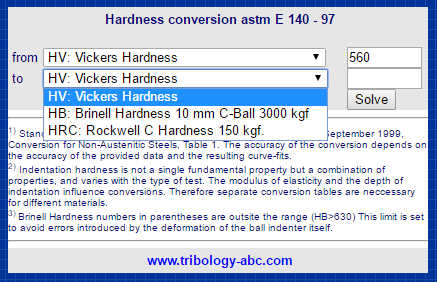
Our calculator can convert steel hardness between different scales in two steps:
Select which hardness number you want to convert from.
Browse the Barrus range and find the right device for your needs – whether it’s based on Rockwell, Brinell, or other methods.
Hardness conversion calculator according to ASTM E140/97
Contact us
Looking to enhance your material testing process?
We’re here to help.
Contact our expert team for immediate support in English, German or Italian.
Contact
Using the hardness conversion calculator effectively requires understanding the input requirements, scale limitations, and accuracy considerations for different material types and hardness ranges.
Step 1: Enter the Hardness Value
Input the hardness value you want to convert.
How do you convert Rockwell hardness?
Converting Rockwell hardness involves using specific formulas or tables designed for the particular Rockwell scale (A, B, C, etc.) and the target hardness scale. You can learn more about this with our Brinell hardness number calculator.
Rockwell hardness number, calculated from the indentation depth.
Say the steel sample's hardness is 262 HV. By looking up 262 HV on this table, you can see its Rockwell C equivalent is 27 HRC.
You can skip such manual steps by instead asking our calculator to convert HV to HRC. The following section teaches you how best to use this calculator.
🔎 What if, instead of 262 HV, you need to convert 269 HV to HRC?
Generally, when the hardness number you need to convert falls between two values in the table, we reach for the lower value instead of the upper one.
Different scales under the Rockwell scale are labeled HRA, HRB, HRC, etc. There are no straightforward formulae to establish relationships between the different scales, making accurate conversion impossible in most cases.
However, the following steel hardness conversion table was tabulated through extensive data, allowing for approximate conversions.
Brinell HB
Rockwell C HRC
Rockwell B HRB
Vickers HV
800
72
--
--
780
71
--
--
760
70
--
--
752
69
--
--
746
67
--
--
745
68
--
--
735
66
--
--
711
65
--
--
695
64
--
--
681
63
--
--
658
62
--
--
642
61
--
--
627
60
--
--
613
59
--
--
601
58
--
746
592
57
--
727
572
56
--
694
552
55
--
649
534
54
120
589
513
53
119
567
504
52
118
549
486
51
118
531
469
50
117
505
468
49
117
497
456
48
116
490
445
47
115
474
430
46
115
458
419
45
114
448
415
44
114
438
402
43
114
424
388
42
113
406
375
41
112
393
373
40
111
388
360
39
111
376
348
38
110
361
341
37
109
351
331
36
109
342
322
35
108
332
314
34
108
320
308
33
107
311
300
32
107
303
290
31
106
292
277
30
105
285
271
29
104
277
264
28
103
271
262
27
103
262
255
26
102
258
250
25
101
255
245
24
100
252
240
23
100
247
233
22
99
241
229
21
98
235
223
20
97
227
216
19
96
222
212
18
95
218
208
17
95
210
203
16
94
201
199
15
93
199
191
14
92
197
190
13
92
186
186
12
91
184
183
11
90
183
180
10
89
180
175
9
88
178
170
7
87
175
167
6
86
172
166
5
86
168
163
4
85
162
160
3
84
160
156
2
83
158
154
1
82
152
149
--
81
149
147
--
80
147
143
--
79
146
141
--
78
144
139
--
77
142
137
--
76
140
135
--
75
137
131
--
74
134
127
--
72
129
121
--
70
127
116
--
68
124
114
--
67
121
111
--
66
118
107
--
64
115
105
--
62
112
103
--
61
108
95
--
56
104
90
--
52
95
81
--
41
85
76
--
37
80
For example, let's consider a conversion from HV to HRC.
Consider the material type and application requirements. The calculator will convert it to all the other remaining hardness scales!
FAQs
What is the Vickers hardness number of steel with 300 BHN?
The equivalent hardness of a steel sample of 300 BHN in the Vickers scale is 303 HV. The conversion process typically involves using empirical formulas or standardized conversion tables.
We get these numbers by performing indentation tests on the material. The different hardness scales use different loads, different indentor shapes, and different measurements to obtain the hardness number. The general formula is:
HR = E – e
Where:
E is a constant depending on the indenter form
e is the permanent increase in indentation depth (in units of 0.002 mm)
The specific constants and procedures vary for different Rockwell scales (A, B, C, etc.).
What is the ISO standard for hardness conversion?
The International Organization for Standardization (ISO) has established several standards related to hardness testing and conversion.